The third bottleneck: from agreed spec to controlled delivery
Coding agents made code cheap, then deciding what to build became the constraint. Now a third bottleneck has joined it: trusting what many agents produce.
When we started Kairo, coding agents had just made writing code cheap, and the hard part had become deciding what to build. That is still true, but a third bottleneck has now joined it. Here is what we learned from building with agents ourselves and from our design partners, and what Kairo is becoming because of it.
The first bottleneck was code
For most of the history of software, writing code was the slow part. Teams planned around it. Estimates, sprints, story points and a well-groomed backlog all existed so that engineers always had the next piece of work ready.
The tools most of us grew up with were built for that world. Their job was to split work into pieces small enough for people to build, and to predict how long people would take.
Coding agents changed that quickly. A well-described change can now come back from an agent in hours. Writing code stopped being the constraint.
The second bottleneck is deciding
Once code got cheap, the constraint moved upstream. If an agent will build whatever you describe, the quality of the description decides the quality of the result.
That insight shaped the Kairo workspace, from its architecture to its interface: one shared place where product, design and engineering agree on each change, grounded in the codebase, sharpened by AI that asks the questions nobody thought of, and served to coding agents over MCP.
That work mattered, and it still does. But once our design partners had specs their agents could build from, they ran into something new.
The third bottleneck is trust
Our design partners don’t run just one agent. They run several, in parallel. And the questions they bring us are no longer only about what to build.
Which agent is working on what? The agent says it’s done, but what was actually checked? Is the plan the team agreed on still the plan the agent followed? When something gets stuck, who can unblock it, and is there a record?
This is the third bottleneck. Writing code is fast. Deciding what to build is still hard, and it is still where everything starts. Now a third problem sits on top of it: coordinating many agents and trusting what they produce, without putting a human back in the loop for every step.
What Kairo is becoming
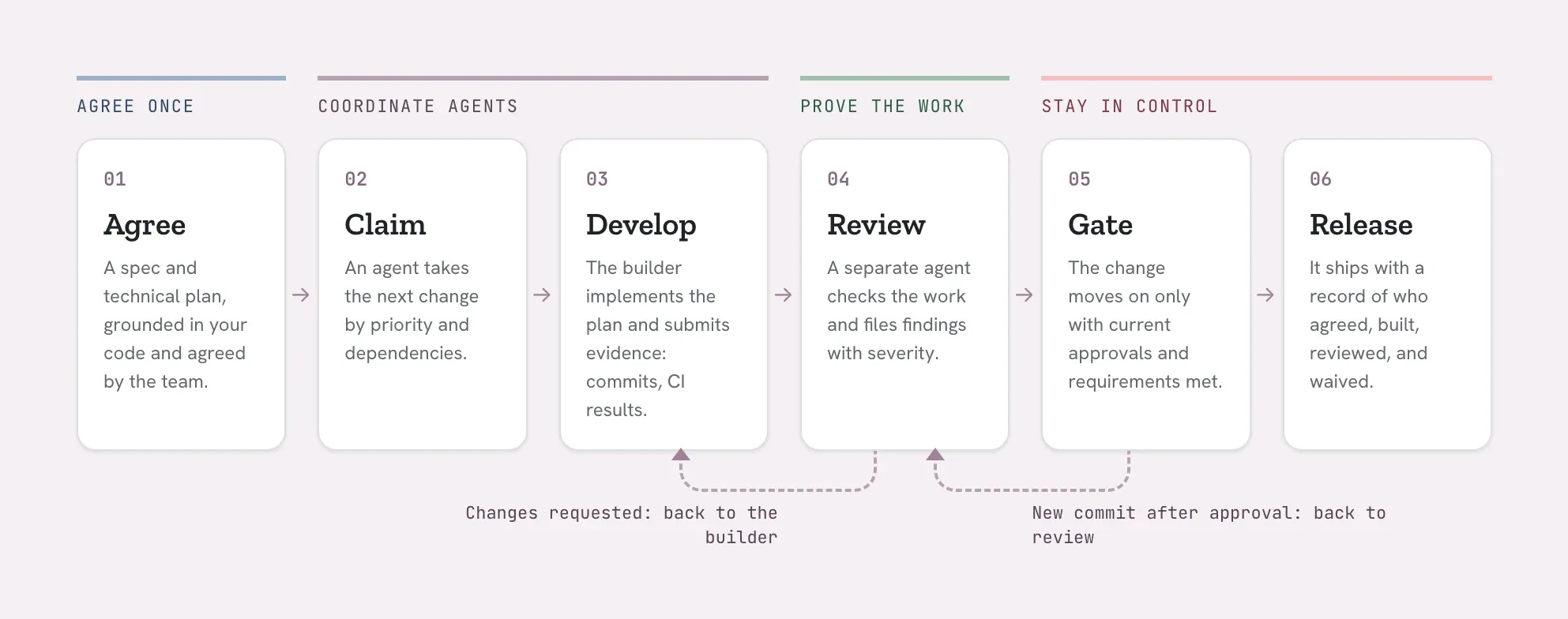
So Kairo is taking the next step: from agreeing on the spec to controlled delivery against it.
Every change still starts as a change request the team agrees on. Coding agents now watch the board and claim the next change request by priority and dependencies, so no two agents work on the same thing. As they work, they submit evidence: commits, CI results, progress against the plan.
A separate reviewer agent checks the plan, the milestones and the result, and files findings with a severity. That reviewer can even come from a different vendor than the agent that built the change.
Approvals point to the exact commit or document version they approved. If the work changes, the approval goes stale and the change goes back for review. Nothing moves forward until it clears a gate: gates stop anything that doesn’t match what was agreed, and they say what is missing.
None of this takes people out of the loop. They set the rules, and they can waive a requirement or release a stuck claim when they need to. Every exception is on the record.
Building on the agreement
None of this replaces what Kairo already does. The agreement is what makes control possible: you cannot check that work matches the spec unless there is a spec everyone agreed on. What changes is how far Kairo carries it.
We are building this with our design partners, and we use it every day to build Kairo itself. If you run several coding agents and recognize the questions above, we would like to hear how you handle them today.