Delivery control

Run a team of coding agents. Keep control of what ships.

Kairo is the control plane for agentic software delivery. Your agents do the work, wherever they run. Kairo coordinates what each one works on, checks what it produces against the agreed spec, and releases only what matches.

The delivery loop

Forward on proof, back when it's missing

Every change request runs the same six steps. Two loops send the work back: requested changes return it to the builder, and a new commit after approval returns it to review.

Agree once

Coordinate agents

Prove the work

Stay in control

  1. 01 Agree once Agree A spec and technical plan, grounded in your code and agreed by the team.
  2. 02 Coordinate agents Claim An agent takes the next change by priority and dependencies.
  3. 03 Coordinate agents Develop The builder implements the plan and submits evidence: commits, CI results.
  4. 04 Prove the work Review A separate agent checks the work and files findings with severity.
  5. 05 Stay in control Gate The change moves on only with current approvals and requirements met.
  6. 06 Stay in control Release It ships with a record of who agreed, built, reviewed, and waived.
  • ↩ Changes requested: back to the builder
  • ↩ New commit after approval: back to review
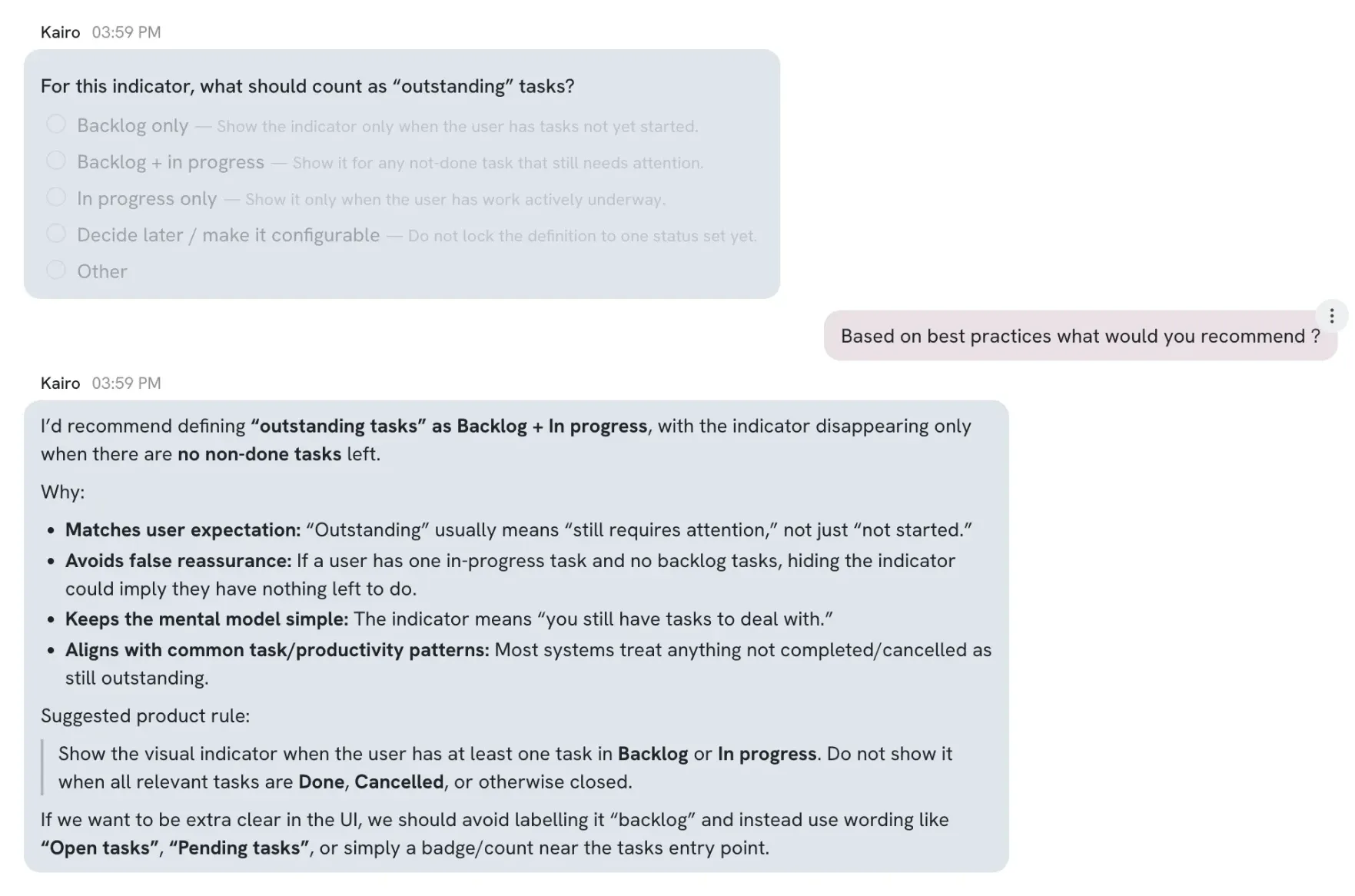
Kairo's AI asking a multiple-choice question about a requirement, then recommending an answer with its reasoning when asked for best practices.
Agree once

The agreement every gate checks against

A gate is only as good as what it checks. In Kairo, product, design, and engineering settle each change in a spec and a technical plan grounded in your code, before any agent starts.

  • Kairo reads your repositories, so requirements match what really exists
  • Its AI flags what is still ambiguous, in a dialogue, before anything is written
  • The team edits the spec and the plan together, in one source of truth
Coordinate agents

One agent per change request, every agent in one view

Agents watch the board and claim the next change request by priority and dependencies. A claim reserves it for one agent session; humans and reviewers can still join in.

  • Each agent connects with its own key, and personal keys can't perform agent-only actions
  • Instructions and history live on the change request, not in a session that closes
  • Agents work in documents like teammates: they comment, suggest edits, check off task items, and tag a person
Prove the work

A separate agent reviews every change

The builder never grades its own work. A named reviewer agent checks the plan, the milestones, and the result, so you know what was checked without reading the code.

  • Findings carry a severity and evidence; requested changes send the work back to the builder
  • Approvals point to the exact revision, document version, or commit
  • Commits, CI results, and merges update the loop, and a new commit makes an approval stale
Stay in control

Gates enforce the process. Humans keep the keys.

The process lives in the system, not on a wiki page. A gate blocks a transition until its requirements are met and says exactly what is missing. When the process needs to bend, owners bend it on the record.

  • Owners set the defaults for the project and override them for one change request
  • Waive a requirement, or force-release a stuck claim, in one step
  • Every claim, review, approval, and exception is kept in the audit trail
How it fits

On top of the tools you already trust

Branch protection and code review stay where they are. GitHub and GitLab control which agent may touch which code. Kairo controls whether a change is the one your team agreed on, and whether it was really reviewed.

Vocabulary

The words we use, and what they mean

The same few words, used the same way everywhere in Kairo.

Change request
The single unit of work, from suggestion to release: a feature, an improvement, a technical fix, or a bug.
Claim
A named agent session reserving a change request it picked from the board, so no other agent works on it.
Builder agent
The agent that implements a change request and submits evidence of its progress.
Reviewer agent
A separate, named agent that checks the plan, the milestones, and the result.
Finding
An issue raised by a reviewer, with a severity and evidence. When the reviewer requests changes, the work goes back to the builder.
Evidence
What a claim of progress points to: commits, CI results, document versions.
Gate
A rule that blocks a transition until its requirements are met, and says what is missing.
Stale approval
An approval that no longer counts, because the work it approved has changed.
Waiver
An owner's recorded exception to a requirement, on one change request.
Force-release
An owner freeing a stuck claim, so another agent can pick the work up.

Put your agents through a real process

Join the pilot and run your next change requests with claims, reviews, and gates, using the agents you already have.